Sidelines
Thoughts and more ...
Wednesday 3rd June 2026 - What Makes a Writer Write?
People sometimes ask me why I write, and the truth is that I’m not entirely sure. What I do know is that writing has become a release for a mind that rarely rests. My brain has always been busy. It seems incapable of leaving anything alone, forever wandering off down side roads, asking questions, spotting patterns, and wondering what might happen if one thing were changed ever so slightly (note to self to add a story about an event when I was 14 years old another day!). Ideas appear with remarkable frequency. The challenge has never been generating them; it has been finding somewhere for them to go.
The funny thing is that I didn’t discover writing until relatively late. One winter evening, at the start of a long train journey, I found myself with several hours to fill and a laptop sitting open in front of me. Not long before that, I had cancelled an expensive annual subscription to Microsoft Office because we hardly used it at home. Faced with a blank screen, I reluctantly opened the free word processor that came bundled with my Mac, a piece of software I’d barely touched and had largely ignored. To my surprise, it was excellent. Before long I was typing away, and somewhere between London and Preston I stumbled across something I never expected to find: a love of creative writing.
Looking back, I probably should have seen it coming. My life has been one long sequence of interests, hobbies and enthusiastic diversions. I’ve learned to fly a light aircraft, served as a magistrate, picked up and put down a guitar more times than I care to admit, survived around a dozen drum lessons, started learning Italian before quietly abandoning it, and begun learning Dutch, which more than three years later I am still stubbornly pursuing. Along the way there have been countless other interests, some serious, some fleeting, and some so thoroughly forgotten that I can no longer remember what they were. Curiosity has always been one of my defining characteristics. I like understanding how things work, seeing what lies beneath the surface, and occasionally disappearing down rabbit holes simply because they happen to be there.
Most hobbies eventually settle into their proper place. They become something you enjoy from time to time, something that occupies a corner of your life. Writing didn’t do that. Writing took over the room.
The truth is that I’m clearly obsessed. My wife would probably confirm this without hesitation. What surprises me is not that I enjoy writing, but the extent to which it has rewired the way I look at the world. Every situation I encounter throughout the day is quietly assessed by a little process running somewhere in the background of my mind. Whether I’m standing in a queue, overhearing a conversation in a café, watching somebody walking a dog, sitting on a train, or simply noticing an odd sign in a shop window, part of my brain is constantly asking the same question: Is there a story in this?
Most of the time the answer is no. Occasionally it is a definite maybe. Every now and then it is a resounding yes, and off my imagination runs before I have any chance of stopping it. A stranger becomes a character. An ordinary event becomes the opening chapter of a novel. A throwaway remark develops into an entire plot. I suspect many writers will recognise this tendency. Once you start looking for stories, it becomes remarkably difficult to stop.
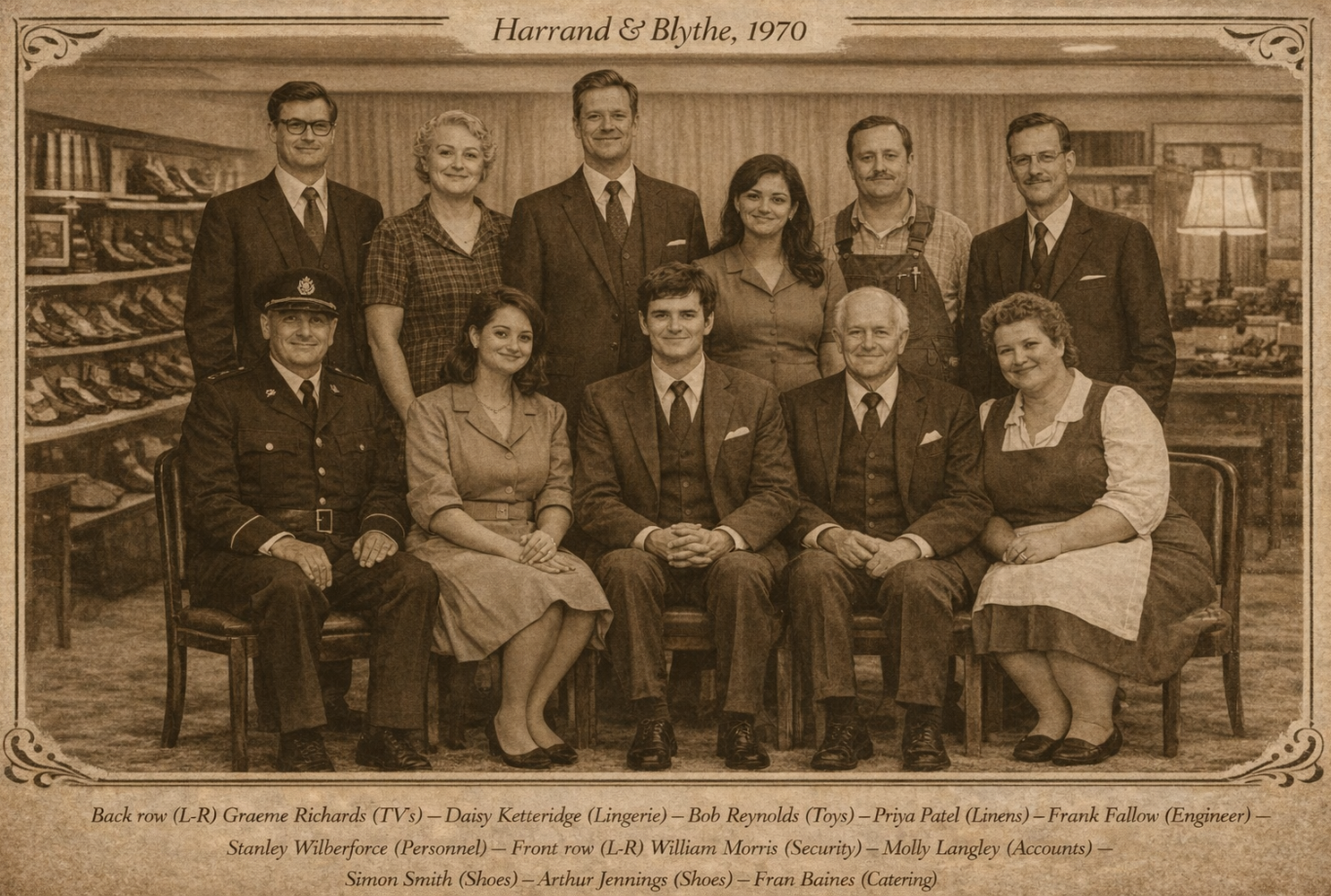
What I love most is that writing gives all those wandering thoughts somewhere to live. Instead of bouncing endlessly around inside my head, they can become people, places, mysteries and adventures. The characters themselves often feel strangely familiar. I suspect every writer borrows from life, whether consciously or not. There is usually a little of ourselves in every character we create, alongside pieces of people we have known, admired, worked with or simply observed over the years. (There is more than a little of my younger self in Simon's early experiences at Harrand & Blythe, which draw heavily on my first job in Nuneaton and the feelings I experienced at that time). A mannerism here, a sense of humour there, a particular way of speaking, a memory, a hope, a fear. Over time these fragments combine to create somebody entirely new.
One of the greatest surprises has been how real those characters begin to feel. Before I started writing, I would have laughed at the idea. Yet after spending months with a character, listening to their conversations and following their journey, you develop a genuine affection for them. You find yourself wondering what they would do next. You worry about them when things go wrong. You feel pleased when they succeed. Occasionally they even surprise you by taking a story in a direction you hadn’t planned. Non-writers may think that sounds faintly ridiculous, but I suspect many writers will be nodding in agreement.
What has surprised me even more is discovering that readers can become just as attached. One of the most gratifying pieces of feedback I've received came from a reader who seemed upset when a character died. In another case, I even received a light-hearted complaint about it. At first, I felt a little guilty. Then I realised it was actually one of the nicest compliments a writer can receive. If somebody feels sadness when a fictional character leaves the story, then for a little while that character must have felt real to them too. Somewhere between the writer's imagination and the reader's imagination, they briefly became a person rather than a collection of words on a page.
Perhaps that is what writing ultimately is for me. It is a way of giving shape to curiosity. It allows me to explore ideas, people and possibilities that would otherwise drift through my mind and disappear. More than anything, it gives me an excuse to ask "what if?" over and over again. It also provides a wonderful creative counterbalance to my day job. Banking is built upon accuracy, rules, controls and certainty. Writing allows me to wander off in entirely the opposite direction. One part of my life is concerned with facts; the other is free to invent them.
As I write this, I have several books either published, being edited, or sketched out in notebooks and documents and new ideas continue to arrive with astonishing regularity.
People occasionally ask how many books I hope to sell. The answer tends to surprise them.
My sales target is zero.
That doesn't mean I don't appreciate every reader who chooses to spend time with one of my stories. Quite the opposite. Every sale, every review and every message from a reader is genuinely appreciated. But writing was never part of a grand business plan. I didn't sit down on that train journey dreaming of bestseller lists, literary awards or early retirement. (Lie, I do think about early retirement, who doesn't right?)
Writing is not, for me, a way of making a living.
It is a way of living.
The stories would still arrive whether I published them or not. The characters would still wander into my head. The plots would still emerge from overheard conversations and everyday observations. Publishing simply gives those stories a chance to find a home beyond my laptop.
Of course, earning a little money from writing is lovely. Seeing somebody buy one of my books is a wonderful feeling. Yet if money became the primary reason for doing it, I suspect some of the joy would disappear. The real reward comes much earlier in the process: that moment when a story idea suddenly clicks into place, when a character says something unexpected, or when a reader tells you they laughed, cried, or found themselves thinking about a fictional person days after finishing the book.
Those moments are worth far more than any royalty statement.
Which makes me think about you ...
What is the thing that captures your attention so completely that hours disappear without you noticing? What is the interest that began almost by accident and somehow became part of who you are? It may not be writing. It could be gardening, photography, music, cooking, travelling, restoring old cars, learning languages, or something entirely different. Most of us have something that sparks that combination of curiosity, enthusiasm and joy.
Perhaps yours is something you've done for years. Perhaps it's something you've not discovered yet. Mine arrived unexpectedly on a train journey and quietly took over a significant portion of my life. Looking back, it feels inevitable, as though all those abandoned hobbies, curiosities and rabbit holes were somehow leading in the same direction.
A long train journey, a free word processor I’d never used before, and a mind that refuses to sit quietly for five minutes were all it took.
Who knew?
Sunday 31st May 2026
News !!! My next book has been uploaded to Amazon and is ready for Pre-Sale (Kindle only).
It is called 'The People Next to You' and is a tale of queues, British eccentricity, the quest for a bargain and unexpected friendship.
Now, head over to the gallery for a glimpse of the Amazon 'KDP' editing software, where books are shaped into a Kindle-ready format ... and if you squint, you'll be able to read the first page...
For those of you who prefer printed books, three of my works (including this one) will be stitched together in the next few weeks and released as a paperback on August 4. Details to follow.
Tuesday 26th May 2026
In the words of Neil Diamond… “Where it began…”
There’s so much swimming around in my head these days that I suspect I’ll be back here rather often. It feels only right that the very first post should begin with a story related to my first novel, The Heroes of Harrand & Blythe.
The strange thing is that the book itself — or at least fragments of it — had been quietly living somewhere in the back of my mind for forty or fifty years. Odd scenes. Half-formed ideas. A department store that felt just a little unusual. A hidden place beneath it. Characters who never entirely went away.
Then came a long winter train journey from London to Blackpool.
I’d never seriously attempted creative writing before, beyond the usual school essays and the occasional abandoned idea scribbled on paper. Yet something about that journey unlocked the door. Around twenty minutes before departure, I opened my laptop and started writing. I barely looked up again until more than three hours later as the train rolled into Preston.
And from there, everything changed.
The first draft of Harrand & Blythe was, if I’m being honest, fairly dreadful in places. But the heart of it was there. Over the following months I rewrote, reshaped, deleted, expanded, doubted myself repeatedly, and then started all over again. Entire sections vanished. Others appeared from nowhere. Slowly, very slowly, the story became the book I had hoped it might be.
A few months later, The Heroes of Harrand & Blythe found its way onto Amazon.
I’ll save the tale of that first publishing experience for another blog post — because trust me, there’s plenty to tell there too.
To round off this first little introduction, here’s an AI-generated image that's evolved from my description of Arthur Jennings, the central character, and company … or at least very close to how he’s always appeared in my imagination. Not all of these characters and names survived, so don't be confused!