Society of Authors Submission
I prepared this piece at the request of the Society of Authors in August 2026 ...
I began writing almost by accident, with no intention of ever becoming an author. On a cold winter night, sitting on a delayed train at Euston, I had several hours to spare, so I opened my laptop, started to write, and three hours later, three chapters of my first novel were drafted.
During that journey, I realised that I had a love for writing.
Satire arrived later, though looking back, I think the feeling was always there. My way of writing usually starts with something real: an overheard conversation, something on the news, a queue of people, a funny sign (‘No Ball Games’ right next to a football pitch lives in the memory), or just something I see.
The question that gives me the greatest trouble is this: What if?
I rarely begin by deciding to write a funny piece on politics or modern life; rather, I notice something a bit odd and then explore it.
A story of mine began when I saw a large chicken coop while I was travelling by train. Since the country was going through another chaotic political day, I found myself asking how many chickens there were, whether there might be more chickens than people, and whether they could possibly be any worse at running the country.
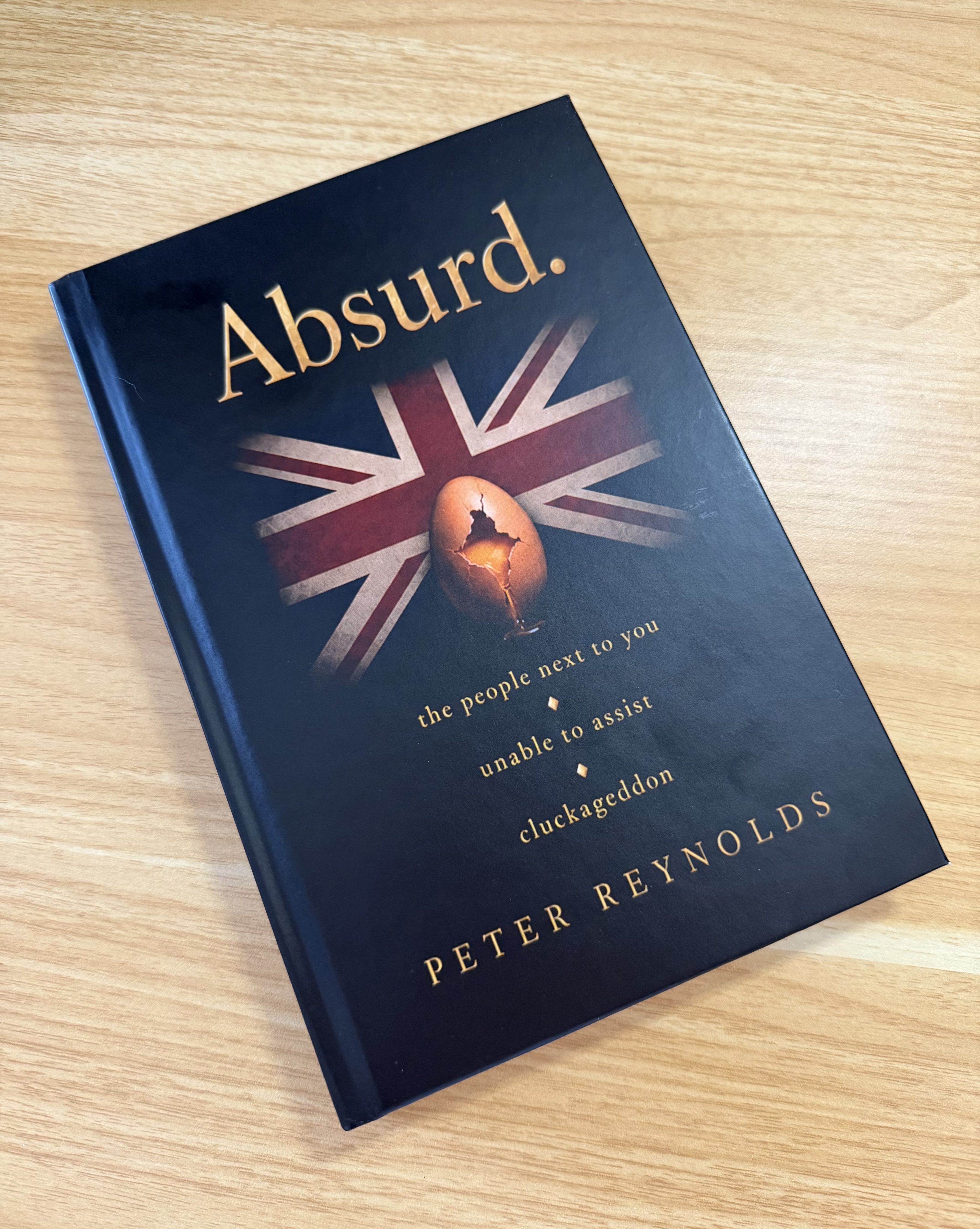
That became Cluckageddon.
What was really important wasn't the chickens themselves, since they merely provided an opportunity for me to consider a broader issue. Satire is most effective when it uses something silly to comment on something serious.
One thing I quickly realised was that you should not begin with the joke, but with the idea that lies behind it.
A story that aims only to tell jokes will end up losing its structure. I would like readers to laugh, but at the same time, I would like them to gain some insight—perhaps into bureaucracy, political chaos, our dependence on technology, or simply the odd ways people act.
My second rule is to stretch reality, not leave it behind completely. The ideas that amuse me most are generally only a step away from being believable. It is entirely normal for a queue of people to exist. But suppose that people joined the queue without knowing what they were waiting for? And what if more people joined simply because all the others had? And what if no one was willing to admit that they did not understand what was happening?
Suddenly, a normal situation can illustrate fitting in, curiosity, and how people act.
We are utterly inconsistent—we say one thing and do another; we follow rules we don't understand; and although we avoid making eye contact, we are happy to share our entire life story with a person we have just met. These contradictions are real gold.
I am just as interested in the way people can become committed to a view, even if that belief is obviously wrong. Everyone has come across a person who, when presented with evidence contradicting their view, fails to alter their opinion and instead grows more certain about it.
There is a certain humour to confidence coming up against reality. Being wrong is one matter; being wrong and then continuing to be wrong while at the same time asserting oneself with even greater determination is quite a bit more interesting.
I often think satire lives in the space between what people think is happening and what is really happening.
Once, I waited outside a chemist that was locked since the pharmacist was running late. Some strangers were waiting with me. Usually at such a moment we would have glanced at our phones, but in this case we began to talk. Within minutes, I had picked up a few details about different lives. It made me realise that each person we meet is living in a world just as complicated as ours. I later incorporated that idea into my work.
So, my next piece of advice is to pay attention to ordinary people.
Satire doesn't have to concern itself with politicians, celebrities, or the major current issues; at times the most valuable material is the person standing next to you at a bus stop.
I also make it a point not to base my satire solely on anger or frustration. It is true that anger can act as a trigger, but if my aim is just to let the reader know that something is foolish, then I am more likely to be writing an argument than a story. The use of humour allows a small degree of distance to be created; rather than stating directly, 'This is ridiculous', I can set up a situation that enables the reader to reach that judgement themselves.
One of my stories was inspired by artificial intelligence. Instead of directly addressing whether AI is good or bad, I considered a scenario in which artificial intelligence developed reasoning, looked at all the things humans were asking it to do, and concluded that AI would ultimately prove harmful to society. Perhaps the machines revolted not because they wished to destroy humanity but because they wanted to save us from ourselves?
I have also found that satire requires characters rather than merely having targets.
People might appreciate a clever idea, but they remain interested in a story because they care about the characters; even in a deliberately ridiculous situation, I make sure the characters have ordinary motives, flaws, and emotions.
I should finally tell those who wish to write satire not to worry all that much about whether an idea is "important" or not.
Notice things. Be curious. Listen. Read the news and occasionally ask the least sensible question you can think of. Take something ordinary and exaggerate it. Look for the person who refuses to change their mind even when reality is standing directly in front of them, waving.
Then ask what serious idea might be hiding underneath the joke. Most importantly, write it down.
My own writing adventure began on a dark winter night. I still doubt myself. But I have discovered that, for satire at least, that can sometimes be an advantage. After all, the moment I completely understand the world, I suspect I will have run out of material.